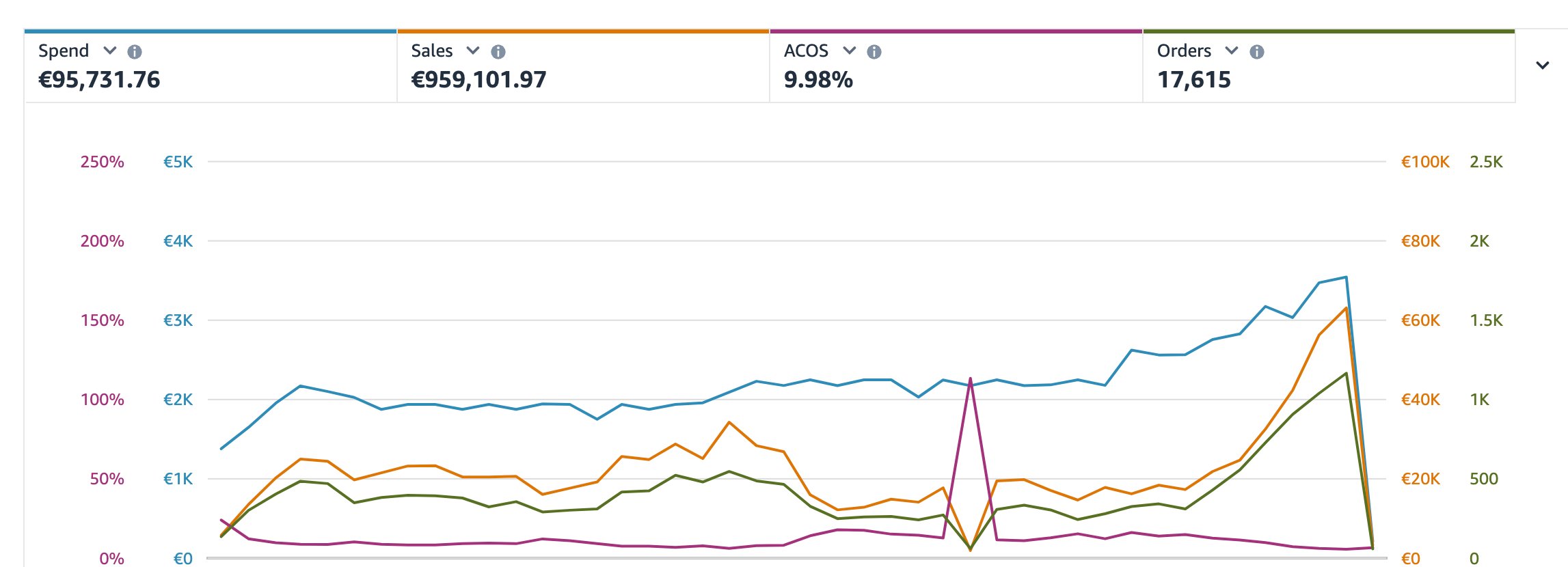
Scaled an automotive parts brand to €959K in tracked ad sales at sub-10% ACoS.
Trailer-Parts4U (Germany). Rebuilt the campaign architecture from the ground up — match-type isolation, search-term harvesting cadence, top-of-search bid modifiers, and competitor ASIN targeting. Result: a profitable scaling curve that compounded month over month while keeping ACoS under 10%.
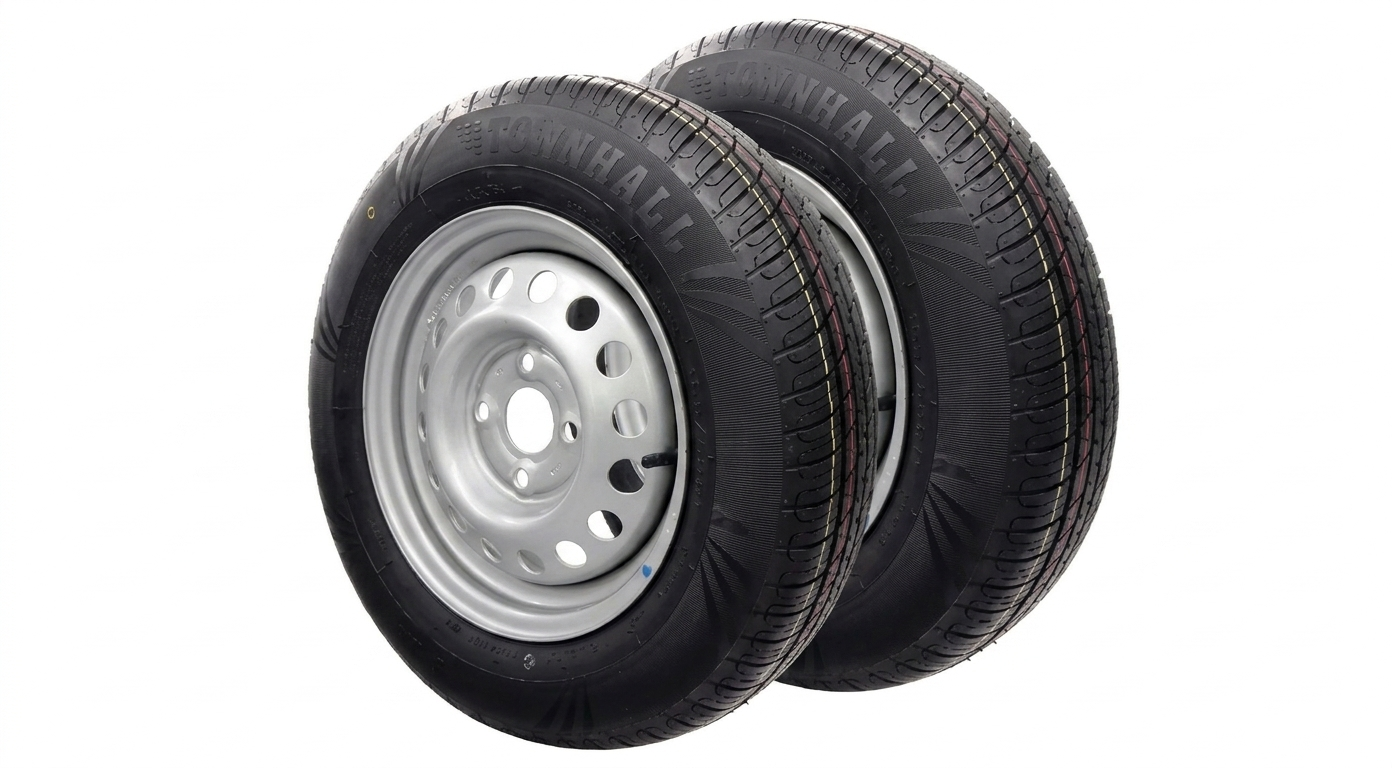
Trailer-Parts4U
User-Centered Design is not just a method—it’s a mindset. By focusing on user needs, businesses can create experiences that drive engagement, loyalty, and long-term success.
A fragmented category, technical buyers, and a search graph that punishes lazy bidding.
Amazon DE’s automotive-parts vertical is unique. Buyers don’t search for products — they search for fitments. “Anhängerkupplung 7-polig 13-polig adapter”, “AL-KO Bremsbacke 200×50”, “Spurstange 12mm Gewinde”. Long-tail technical queries dominate, brand-led queries are weak, and a single mismatched search term can return six near-identical SKUs from competitors at lower price points.
Trailer-Parts4U came in with three structural issues working against the account:
- Match-type chaos. Broad, phrase, and exact match keywords stacked into the same ad groups, fighting each other for impressions.
- No naming taxonomy. Campaign names told you nothing about what the campaign was supposed to do — making optimization decisions guesswork.
- Wasted spend on irrelevant placements. Top-of-search bid modifiers were flat across all campaigns, regardless of which placements were actually converting.
The brief was clear: scale spend without losing the unit economics. ACoS target: under 12%.
Architecture first. Bidding second. Scaling last.
The temptation in an account this size is to start adjusting bids on day one. That’s the wrong move. Bid optimization on a structurally broken account is shuffling deck chairs — every weekly cycle just rearranges the same problems.
The strategic order of operations was:
- Architecture rebuild first — clean SP/SB/SD structure, match-type isolation, naming taxonomy that reads like documentation.
- Search-term harvesting second — convert auto/broad campaign winners into single-keyword exact-match campaigns where ranking matters.
- Bid + placement discipline third — placement modifier tuning, dayparting, and weekly target-ACoS bid adjustments only after architecture is stable.
- Scale fourth — once efficiency holds at target ACoS, redirect freed budget into category ads, ASIN targeting, and Sponsored Display retargeting.
Every campaign should answer two questions in its name alone — what is this campaign supposed to do, and what’s the next decision its data should drive. If a campaign name can’t answer those, the campaign isn’t ready to optimize.
The architecture was deliberately built around the four roles a PPC campaign can play: ranking, profitable sales, brand defense, and research. Most accounts confuse these — running ranking-budget on profit-target campaigns, or competing against themselves on overlapping match types. Trailer-Parts4U’s rebuild made every campaign answerable to exactly one role, which is what makes the rest of the optimization work.
Audit & Foundation Mapping
Weeks 1–3
Bulk-file pull across the full enabled-and-paused inventory. Built a single source-of-truth spreadsheet mapping every campaign, ad group, keyword, and target ASIN to its intent (rank, defense, exploration, scale).
Identified ~31% of total spend going to keywords that hadn't converted in 90+ days, plus duplicate keywords competing across broad and phrase match. Wrote up the wasted-spend findings as a written audit document for the client before touching anything.
- Bulk File Audit
- Wasted Spend Map
- Intent Tagging
- Duplicate KW Detection
Campaign Architecture Rebuild
Weeks 4–8
Rebuilt the SP layer around strict match-type isolation — separate campaigns for broad, phrase, and exact, each with their own daily budget and bid range. This stops broad match keywords from cannibalizing exact-match impression share, and makes search-term harvesting actually meaningful.
On Sponsored Brands, deployed defensive PPD (Product Page Defense) campaigns on the brand's own listings — keeping competitor ASINs from poaching traffic on the brand's hero PDPs.
- Match-Type Isolation
- Naming Taxonomy
- Defensive PPD
- SD Retargeting
- Competitor Conquesting
Search Term Harvesting Cadence
Weeks 9–16
With architecture in place, set up the weekly six-step optimization rhythm. Every Monday: pull the prior-week search-term report, identify converting search terms from broad/phrase campaigns, and either negate them in the source campaign and graduate them to a single-keyword exact-match campaign — or negate non-converters as exact-match negatives.
Over weeks 9–16, this generated 140+ harvested exact-match keywords, each with its own ranking budget and target ACoS. Several of these became top-of-search ranking campaigns for category-defining German technical queries.
- Weekly STR Pulls
- Harvested Exact-Match KWs
- Single Keyword Campaigns
- Negative Keyword Cascade
Bid Discipline & Placement Modifier Tuning
Weeks 17–28
Introduced target-ACoS-driven bid modeling — every bid change tied to the campaign's target ACoS, recent CVR, and 14-day trailing CPC, not gut feel. Placement modifiers tuned per-campaign: high TOS multipliers on ranking campaigns, suppressed product-page placements where competitor PDPs were poaching traffic.
Also introduced dayparting against German buying windows — Tuesday–Thursday peaks, Sunday-evening surge for technical research traffic. Suppressed bids during low-CVR windows (early Monday AM) to free budget for higher-converting hours.
- Target ACoS Modeling
- Placement Modifiers
- Dayparting
- CVR-Based Bidding
Scaling Phase — Compounding the Wins
Weeks 29–52
Once efficiency stabilized below the 12% ACoS target with consistency for 6 weeks, scale phase began. Reallocated freed budget into:
- Category ads — high-volume German technical category targets where the brand had earned organic rank.
- ASIN targeting — competitor-PDP placements on lower-priced competitors where Trailer-Parts4U held the better review profile.
- SD remarketing layer — bringing back PDP visitors who didn't convert on first visit, where 30-day window CVR was 4× cold-traffic CVR.
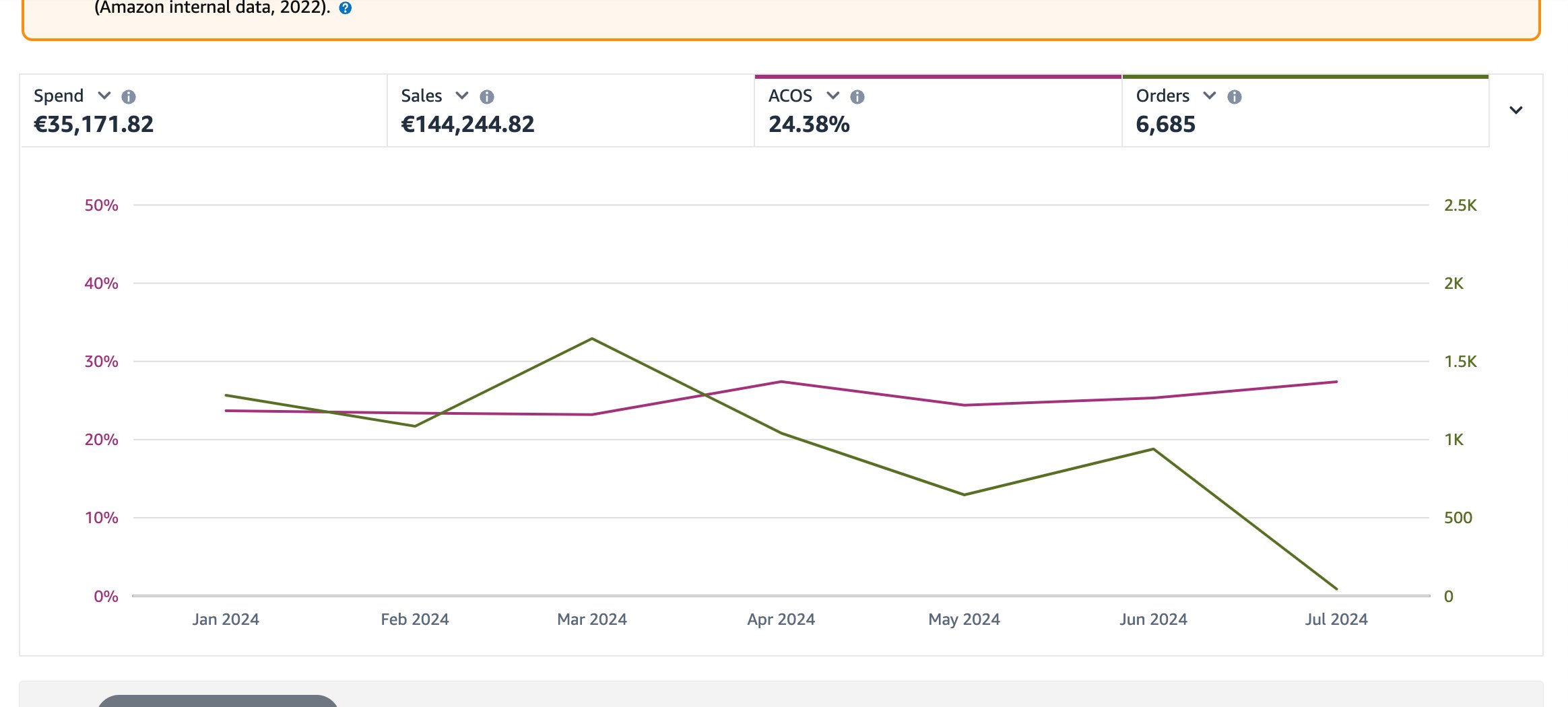
By month 12, ad-attributed revenue had compounded to €959K with a blended 9.98% ACoS — comfortably under the original 12% target, while running a steeper scaling curve in the back half of the year.
- Category Ads
- ASIN Targeting
- SD Remarketing
- Budget Reallocation
12 months of compounding, captured in the dashboards.
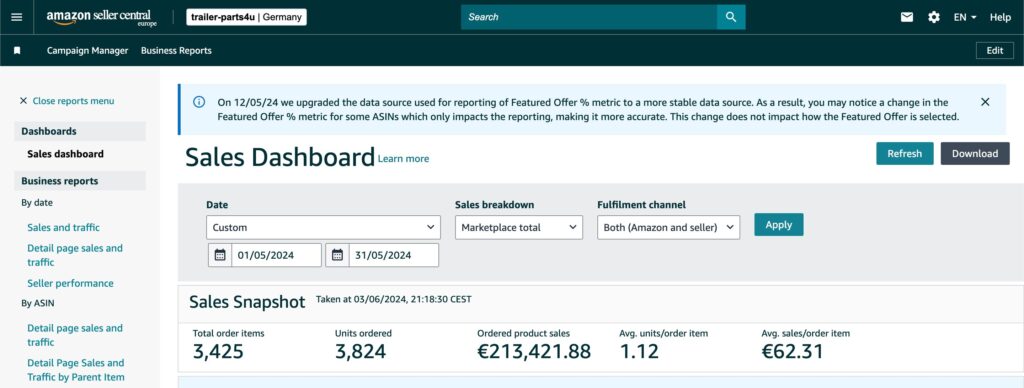
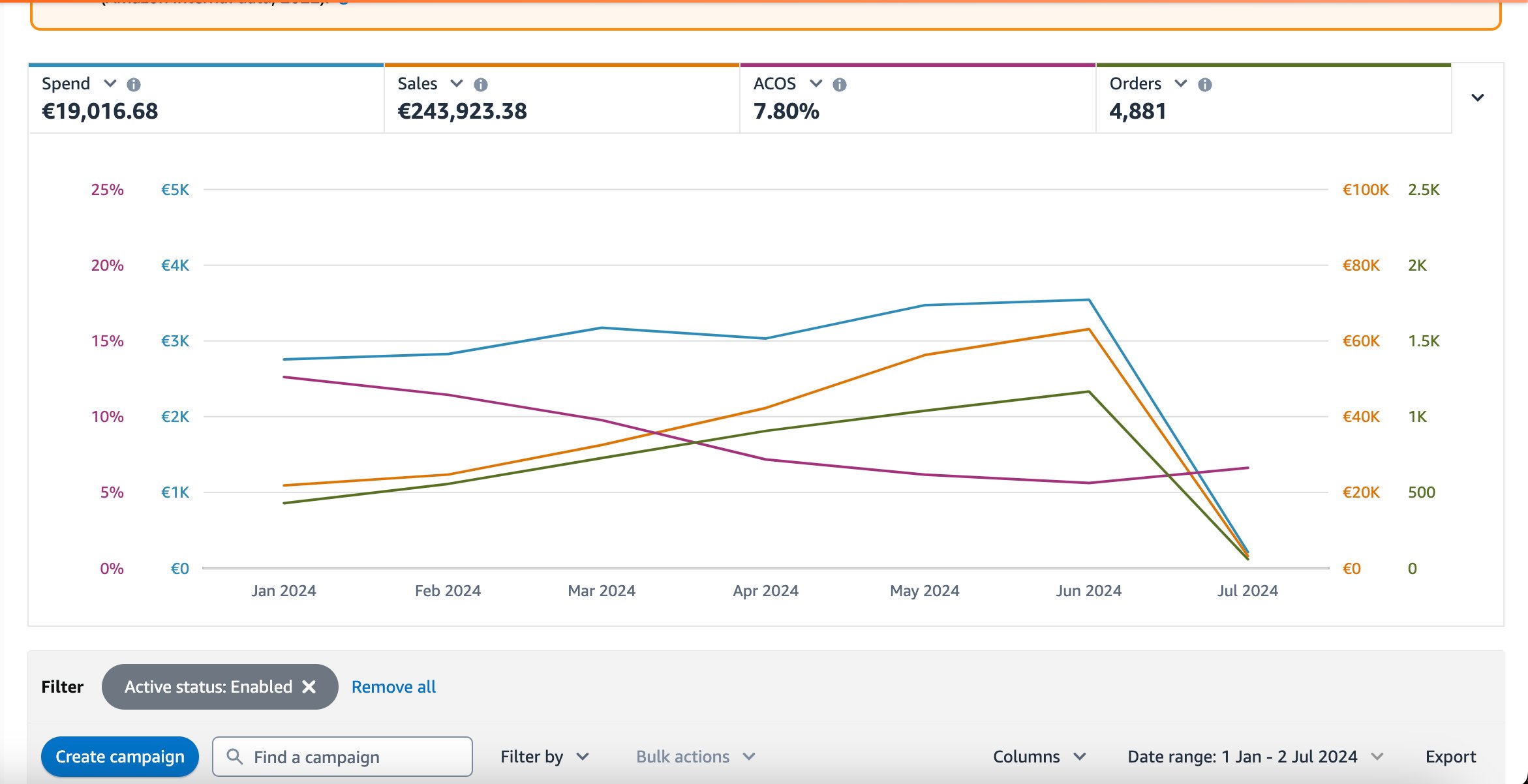
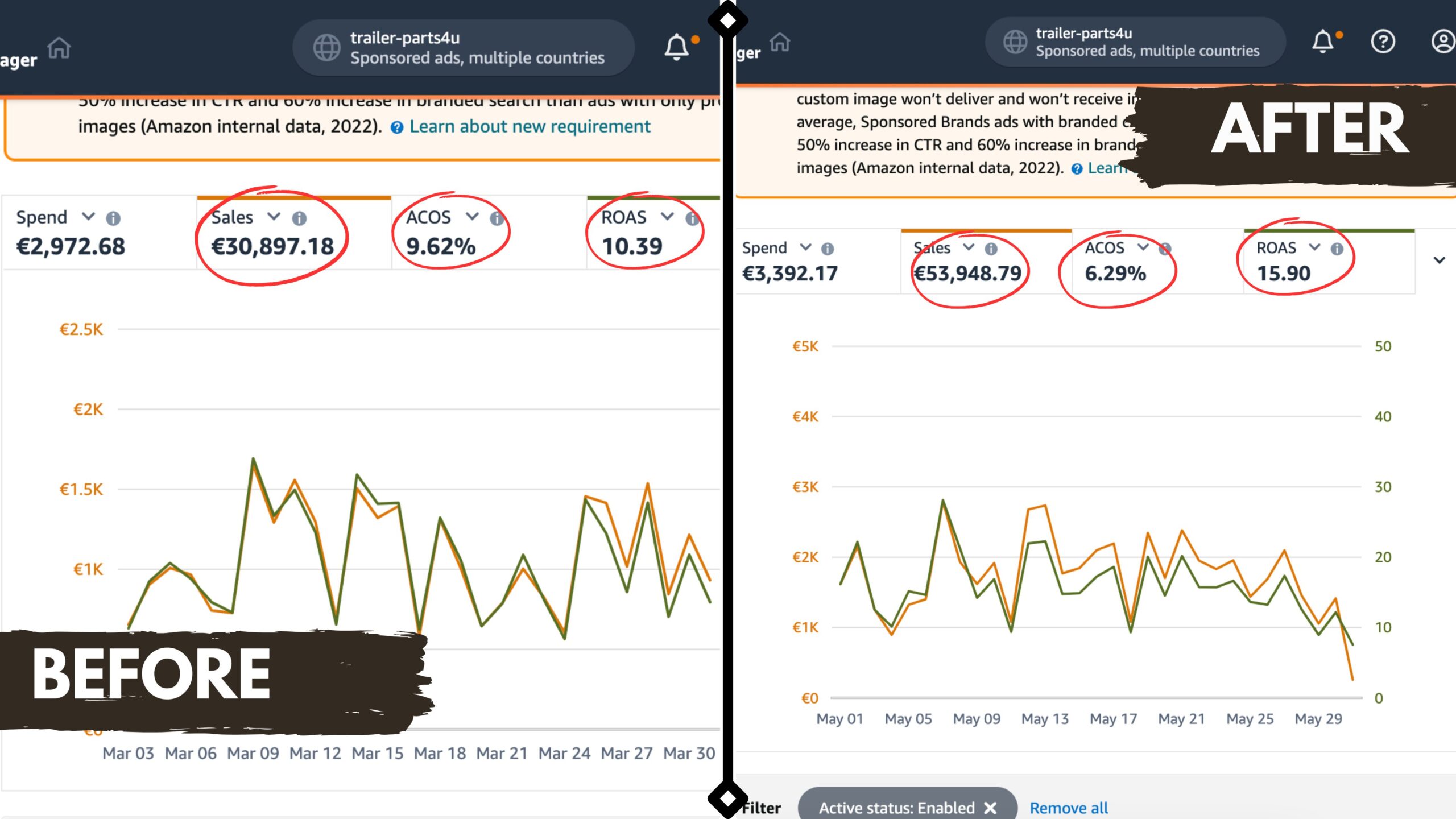
The numbers below are pulled directly from the Amazon Ads Console and Seller Central. A steady scaling curve through Q1–Q2, an inflection point around month 8 when category ads and SD remarketing came online, and a finishing scale phase that drove ad-attributed sales above €70K/mo with ACoS holding under 10%.
Three things that made the difference.
01
Architecture before optimization.
You can’t optimize a structurally broken account. Match-type isolation and clean naming weren’t sexy — but every later improvement compounded because of them.
01
Search-term harvesting compounds.
140+ harvested exact-match keywords, each with their own ranking budget, generated more lift than any single bid change ever did.
01
Dayparting matters in DE.
German buying windows are tighter and more predictable than US patterns. Dayparting against them freed ~14% of monthly budget toward higher-converting hours.