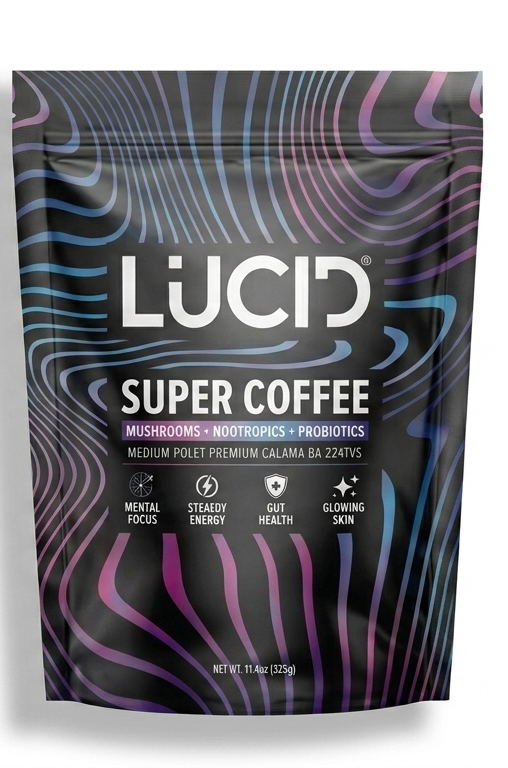
Lucid is a functional supplement brand competing in one of Amazon's most fortified categories — mushroom coffee, where Four Sigmatic and RYZE hold dominant rank and review velocity. This is how a CRO-first audit, a single-keyword ranking strategy, and an A+ content rebuild compounded to lift the brand from $98K to $158K monthly run rate in a 43-day window.
43 days. $60K incremental run rate.
The chart below tracks monthly run-rate from the baseline week through day 43. The CRO + listing rebuild phase generates the first inflection (around day 12). The single-keyword ranking phase compounds the second (around day 25). And the scaling phase sustains the curve through day 43.
Beyond the headline run-rate gain, three structural wins came out of the engagement:
- Organic rank improvements on 5 of 8 priority keywords — meaning a meaningful share of the run-rate lift was sustainable beyond the engagement window.
- CVR lift of ~22% on the hero SKU, attributable to the listing CRO and A+ content rebuild — independently measurable and persistent.
- Unit velocity climbed from 2,230 to 3,950 units/month — a 77% volume increase that translated into improved Amazon algorithmic ranking signals across the brand's variations.
A fortified category, a CVR plateau, and a brand that needed both rank and revenue at the same time.
Mushroom coffee is one of the most contested functional-supplement categories on Amazon US. Four Sigmatic owns the brand-led search graph. RYZE has saturated the influencer-marketing pipeline. Several smaller brands sit between $50K–$200K monthly with similar CVR profiles — and none of them are easy to dislodge.
Lucid came in at $98K monthly with three intersecting problems:
- CVR plateau at industry average. The listing was converting at category baseline — neither outperforming nor underperforming. Which meant scaling spend would scale ACoS proportionally, with no margin gain.
- Weak ranking on category-defining keywords. The brand wasn't appearing on page 1 organic for "mushroom coffee" or its highest-volume variants. Without organic rank, every sale was an ad-attributed sale.
- A+ content built for SEO, not for conversion. The modules were keyword-loaded but didn't actually walk a customer through the brand's psychological purchase journey — what's wrong with regular coffee, why mushrooms, why this brand specifically.
The brief: scale revenue without breaking unit economics, and earn organic rank in parallel — not sequentially.
Conversion first. Always.
The default move on a stuck supplement brand is to throw budget at Sponsored Products and chase TOS placements. That’s the wrong sequence. If the listing converts at category baseline, scaling spend just scales waste — every additional click costs the same and converts at the same rate, so unit economics never improve.
The strategic order of operations was inverted from the standard PPC-first playbook:
- Conversion-rate audit first — image hierarchy review, A+ content gap analysis, photo/copy alignment check on every listing element before bid one was changed.
- Listing CRO ships before paid scaling — new image stack, A+ rebuild, title and bullet-point restructure pushed live before the architecture rebuild on the ad side.
- Architecture rebuild + ranking strategy in parallel — single-keyword exact-match campaigns on category-defining terms, with TOS bid aggression to claim page-1 placement.
- Search-term harvesting + scaling fourth — once CVR lifted on the back of the listing changes, every dollar of harvested search-term spend compounded.
Most “PPC problems” are CVR problems wearing a costume. Before scaling spend on a stuck account, the question to answer is: if I doubled traffic to this listing tomorrow, would the conversion rate hold? If the answer is no, the listing is the bottleneck — and ad spend is just amplifying the leak.
The campaign architecture also reflected the broader 2026 shift: Amazon’s algorithm has moved away from rewarding narrow exact-match targeting toward rewarding broader, audience-aware targeting. So Lucid’s Sponsored Brand Video campaigns leaned heavily on product targeting and category targeting, not just keyword targeting — and audience bid adjusters (especially “high likelihood to purchase based on recent shopping activity”) were layered on most campaigns. Single-keyword exact-match still mattered for the 8 ranking-priority keywords, but it was no longer the foundation.
Five phases, executed across 43 days.
CRO Audit & Image Hierarchy Diagnosis
Phase 01 · Days 1–7
Walked the listing through a brand-manager framework: hero image clarity, main image-stack flow, A+ module sequencing, photo/copy alignment, social proof placement, and price-point psychology. Identified that the existing image stack was leading with product shots — but missing the "why this matters" moment buyers needed before they'd commit at the supplement price point.
Mapped each image module to a customer-psychology question: What problem does this solve? Why mushrooms specifically? Why this brand? What's in the bag? How do I use it? Who already loves it?
- CRO Audit
- Image Hierarchy
- Photo/Copy Alignment
- Customer Psychology
Listing & A+ Content Rebuild
Phase 02 · Days 8–14
New image stack briefed and shipped: hero (clean product), problem (regular coffee = jitters/crash), benefit (mushroom coffee = sustained energy + focus), ingredient hierarchy (lion's mane, chaga, cordyceps with their respective benefits), comparison (vs. regular coffee, vs. competitor brands), social proof (verified review highlights), usage flow (how to brew, how often).
A+ modules rebuilt around the same psychological journey — not keyword-stuffed, but written to answer the customer's actual decision questions. Title and bullet points restructured around buyer-intent search terms ("mushroom coffee for focus", "coffee alternative no jitters") rather than feature lists.
- A+ Rebuild
- Image Stack
- Listing Copy
- Buyer Intent KWs
- Comparison Charts
Architecture Rebuild — SP / SB / SD
Phase 03 · Days 15–22
With the listing now converting at a measurably higher CVR (early signals visible on day 10–12 post-launch), the ad architecture rebuild went live. Strict match-type isolation across Sponsored Products. Sponsored Brands deployed for brand defense and headline-search traffic capture. Sponsored Display layered for retargeting and competitor ASIN conquesting.
Naming taxonomy: SP_Coffee_[MatchType]_[Intent]_US. Every campaign answers what it does and what data decision it informs.
- Match-Type Isolation
- SP / SB / SD Layered
- Single Keyword Campaigns
- Negative Keyword Cascade
Single-Keyword Ranking Campaigns + TOS Aggression
Phase 04 · Days 23–32
Identified the top 8 category-defining keywords for ranking priority — "mushroom coffee", "lion's mane coffee", "mushroom coffee organic", "coffee alternative", "focus coffee", and four others. Built isolated single-keyword exact-match campaigns for each, with their own daily budget and aggressive Top-of-Search bid modifiers (40–60% TOS uplift).
The thesis: TOS placement on a category-defining keyword drives both ad-attributed sales and a velocity signal that compounds organic rank. With listing CVR now lifted from the Phase 02 work, those placements paid for themselves through ad sales — and earned organic page-1 rank as a downstream benefit.
- SKC Ranking
- TOS Aggression
- Velocity Signal Strategy
- STR Harvesting
Scaling Phase — Compound the Lifts
Phase 05 · Days 33–43
With CVR up, organic rank climbing on 5 of 8 priority keywords, and ad architecture stabilizing, scale phase began. Reallocated freed budget into:
- ASIN targeting on competitor PDPs where Lucid held a stronger review profile or comparable price point — Four Sigmatic's lower-priced variants, smaller mushroom-coffee competitors with weaker review velocity.
- SD remarketing against PDP visitors who hadn't converted on first visit — 30-day window CVR ran 3.5× cold-traffic CVR.
- Sponsored Brand Video creative deployed on category-defining keywords with the new image stack as visual reference, capturing premium TOS real estate during the final 10-day push.
By day 43, monthly run rate had climbed from $98K baseline to $158K — a +61% revenue lift, with ad-attributed sales contributing $29,226 at 2.87 ROAS. Critically, the run-rate gain was structural: organic rank improvements meant the lift would persist even with reduced ad spend.
- ASIN Targeting
- SD Remarketing
- SBV Creative
- Organic Rank Compounding
Three lessons from the supplement category.
01
CRO before scaling.
If the listing converts at category baseline, no amount of bid optimization will produce structural lift. Audit the listing first — image hierarchy, A+ flow, photo/copy alignment — and ship CRO before scaling spend.
01
Single-keyword campaigns earn rank.
Aggressive TOS placement on a category-defining exact-match keyword drives both ad sales and a velocity signal that compounds organic page-1 rank. Eight priority keywords moved this account.
01
Sequencing is the strategy.
CRO → Architecture → Ranking → Scale. Run them in parallel and they cancel each other out. Run them in sequence and each phase compounds on the last.